37,538 people live in Claremont, where the median age is 40.4 and the average individual income is $54,496. Data provided by the U.S. Census Bureau.
Total Population
Median Age
Population Density Population Density This is the number of people per square mile in a neighborhood.
Average individual Income
There's plenty to do around Claremont, including shopping, dining, nightlife, parks, and more. Data provided by Walk Score and Yelp.
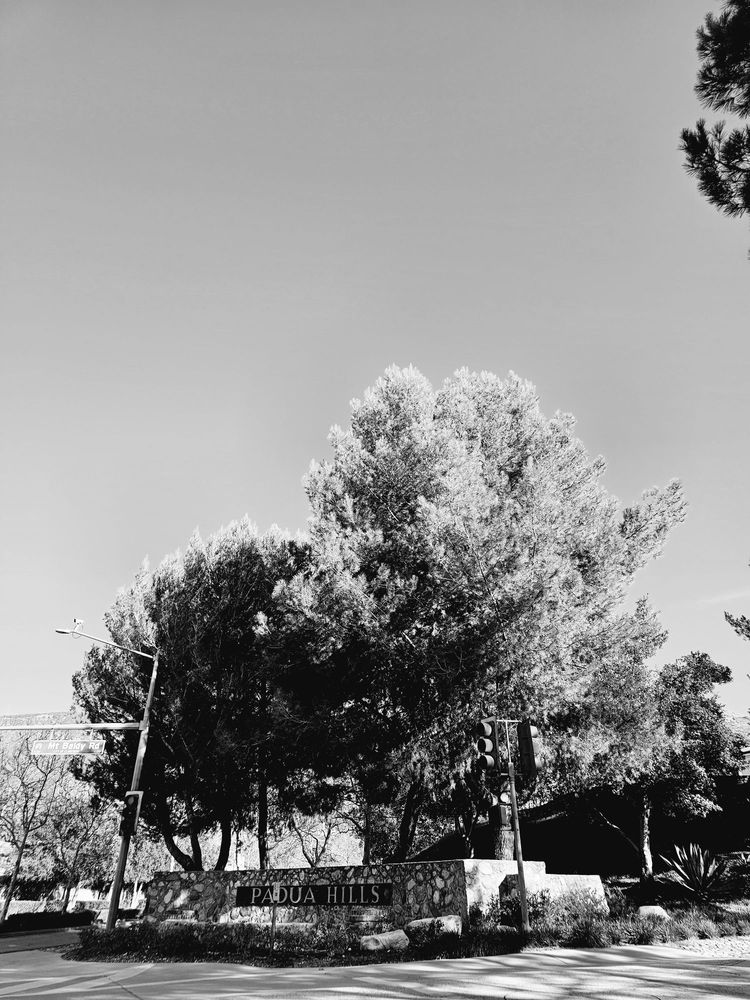
Explore popular things to do in the area, including Padua Hills To-Go, El Trailero Magazine, and Fashion Mart.
| Name | Category | Distance | Reviews |
Ratings by
Yelp
|
|---|---|---|---|---|
| Dining | 1.73 miles | 1 review | 5/5 stars | |
| Shopping | 1.41 miles | 0 reviews | 0/5 stars | |
| Shopping | 1.71 miles | 0 reviews | 0/5 stars | |
| Active | 0.02 miles | 0 reviews | 0/5 stars | |
| Active | 0.17 miles | 0 reviews | 0/5 stars | |
| Active | 0.53 miles | 1 review | 5/5 stars | |
| Active | 0.84 miles | 36 reviews | 4.3/5 stars | |
| Active | 0.96 miles | 11 reviews | 3.7/5 stars | |
| Active | 1.05 miles | 472 reviews | 4.4/5 stars | |
| Active | 1.47 miles | 8 reviews | 4.1/5 stars | |
| Active | 1.62 miles | 172 reviews | 4.3/5 stars | |
| Active | 1.77 miles | 0 reviews | 0/5 stars | |
| Beauty | 0.69 miles | 39 reviews | 4.1/5 stars | |
| Beauty | 0.99 miles | 0 reviews | 0/5 stars | |
| Beauty | 1.24 miles | 0 reviews | 0/5 stars | |
| Beauty | 1.41 miles | 0 reviews | 0/5 stars | |
| Beauty | 1.45 miles | 1 review | 5/5 stars | |
| Beauty | 1.48 miles | 0 reviews | 0/5 stars | |
| Beauty | 1.52 miles | 0 reviews | 0/5 stars | |
| Beauty | 1.52 miles | 128 reviews | 4.7/5 stars | |
| Beauty | 1.71 miles | 8 reviews | 4.5/5 stars | |
| Beauty | 1.72 miles | 185 reviews | 4.7/5 stars | |
|
|
||||
|
|
||||
|
|
||||
|
|
||||
|
|
||||
|
|
Claremont has 12,589 households, with an average household size of 2.58. Data provided by the U.S. Census Bureau. Here’s what the people living in Claremont do for work — and how long it takes them to get there. Data provided by the U.S. Census Bureau. 37,538 people call Claremont home. The population density is 2,513 and the largest age group is Data provided by the U.S. Census Bureau.
Total Population
Population Density Population Density This is the number of people per square mile in a neighborhood.
Median Age
Men vs Women
Population by Age Group
0-9 Years
10-17 Years
18-24 Years
25-64 Years
65-74 Years
75+ Years
Education Level
Total Households
Average Household Size
Average individual Income
Households with Children
With Children:
Without Children:
Marital Status
Blue vs White Collar Workers
Blue Collar:
White Collar:
Claremont gives you several different ways to live near the same Village. A shaded street of older houses, a condominium near the depot and a hillside home above Thompson Creek can all appear in one search. They ask different things of your budget, maintenance plan and weekday routine. Start with the part of the city you will actually use, then compare the houses within it.
For a broad price reference, Redfin reported a $1,039,479 median sale price in Claremont for the three months ending July 2026, across its all-home-types city report. That midpoint is a starting point for understanding the market; it is not a valuation of a particular bungalow, townhome or view property. The Claremont market report and the comparisons below help put individual listings in context.
This guide covers the incorporated City of Claremont in Los Angeles County. Its college campuses, Village streets and foothill neighborhoods belong in the same conversation, but a Claremont mailing address alone does not settle municipal boundaries, school attendance or the rules for a renovation. Check the actual parcel before making those assumptions.
Prepared for Justin Tye Real Estate Group. Sources reviewed September 8, 2026. Market reporting period: three months ending July 2026. Historical team transactions are identified separately below.
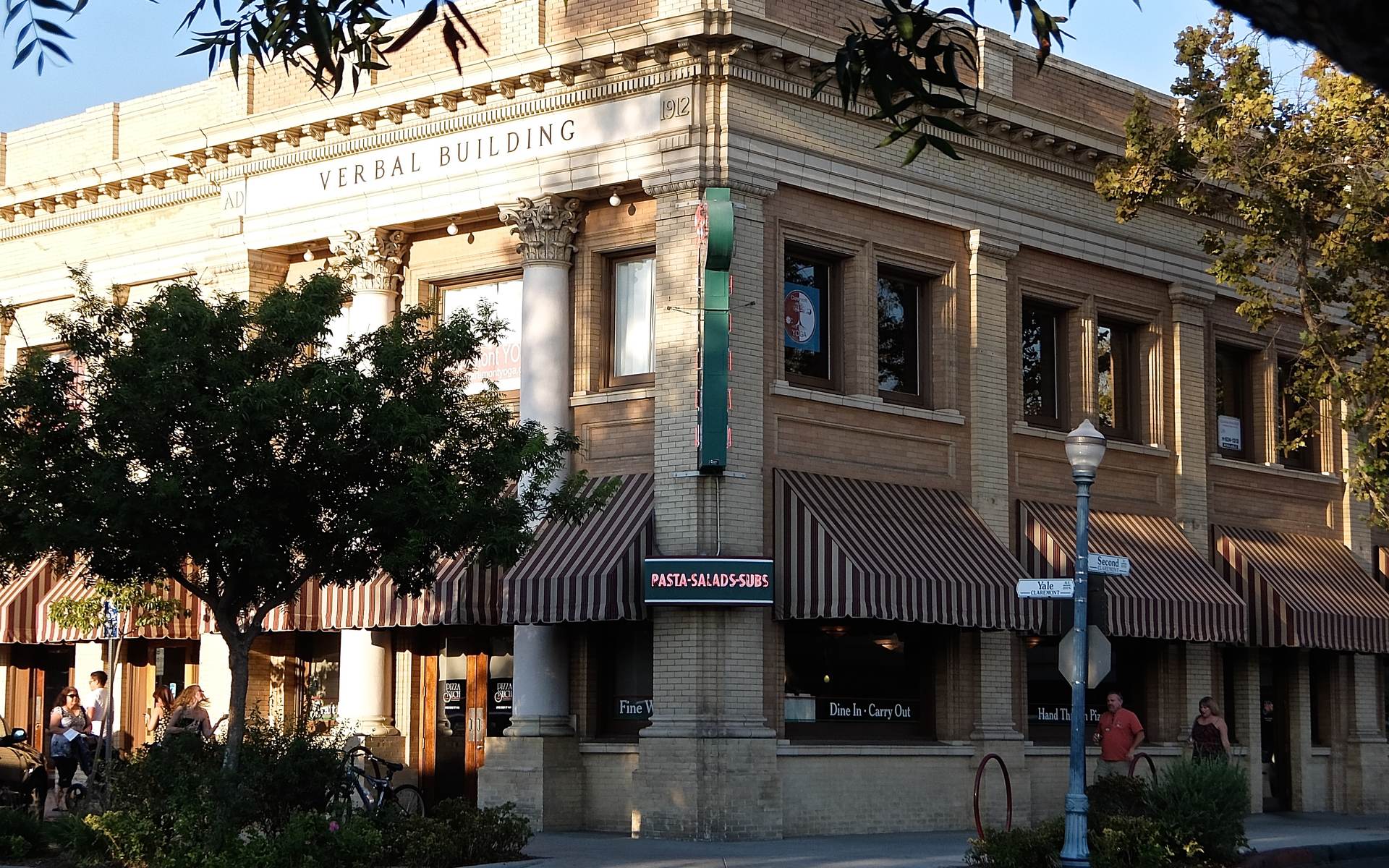
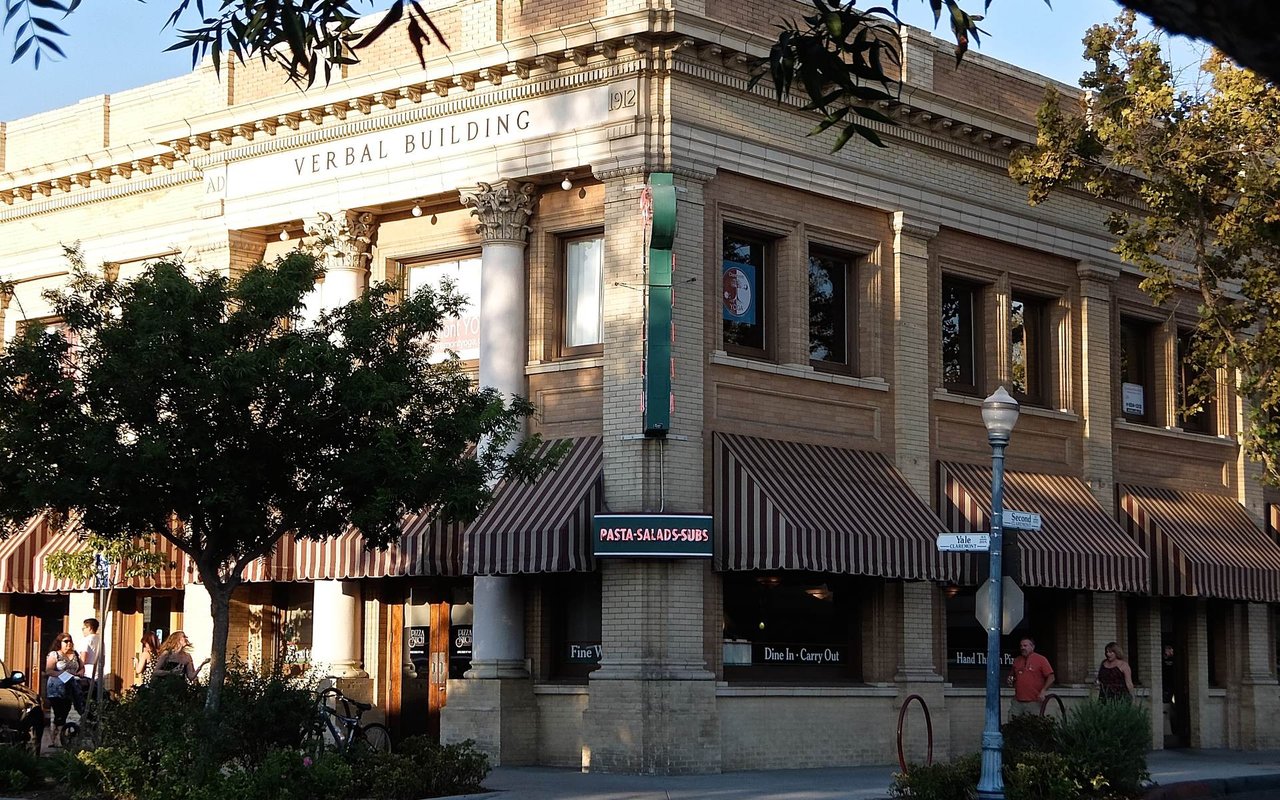
The Village's Verbal Building, photographed in September 2014. Compare the actual walk from a prospective home to the places you use.
01 / The directory
The first useful split is between the Village and older street grid, the established neighborhoods farther north, and the foothill settings. Within each area, ownership, condition and the shape of the lot can matter as much as bedroom count. The city's architectural design guidelines provide a neighborhood-by-neighborhood reference for these distinctions.
Historic Claremont is the older residential area beside the Village and colleges. The city describes houses dating from the 1890s through the 1940s, with varied architecture and scale. A buyer comparing these homes should look beyond a renovated kitchen: original windows, roofing, electrical work, foundations and past additions deserve their own review. An attractive porch can be a reason to visit; the condition of the house behind it is what belongs in the budget.
Old Claremont is a separately described neighborhood, primarily developed from the 1920s through the 1950s, west of Indian Hill Boulevard. That difference is useful when you are comparing a listing described loosely as an “old Village” home. Check the exact block, alley access, garage arrangement and relationship to neighboring buildings. A detached garage or generous-looking rear yard does not by itself establish permission for another dwelling.
Use the city's preservation resources to establish whether a property has a designation or review requirements. Age and historic status are separate questions. Our guide to Southern California home styles can help you describe the architecture you like; Claremont's own planning records govern local project questions.
Village Residential, west of the commercial Village and north of the railroad, includes several housing forms rather than one uniform subdivision. Condominiums and townhomes can put shops and the depot within a more practical routine, but test the route from the actual front door. Count crossings, consider evening activity, and visit with the windows open if a unit faces a busy street or the rail corridor.
For attached homes, ask what you own and what the association maintains. A townhouse describes a building form; it does not answer the legal ownership question. Compare stairs, parking rights, guest spaces, outdoor areas, storage and shared walls alongside dues and reserves. The condo-versus-townhome comparison explains the ownership questions to bring to the documents.
Claremont Club combines attached housing and detached houses in an area the city describes as developed residentially in 1980 and 1981. Compare a lower-maintenance unit with a detached house on its own terms. Ask for the current association package and verify any claimed club access separately. A neighborhood name, a nearby recreation business and a purchased membership are not equivalent benefits.
North Claremont offers another comparison: much of its housing dates to the 1970s, with one- and two-story homes, winding interior streets and larger lots described in the city guidelines. For a buyer seeking usable outdoor space, look at the yard after accounting for the pool, driveway, slope and mature landscaping. A large lot on paper can require a different maintenance commitment from the flat yard you pictured.
Claraboya is the hillside choice accessed from Mountain Avenue, with an early-1960s development history; Highpoint includes terraced townhomes farther up the same approach. Tour for the quality and orientation of the particular view, afternoon exposure and driveway comfort. Do not infer a protected view from a photograph. Review any restrictions and consult the appropriate professionals about slopes, drainage and retaining structures.
Northeast Claremont includes named areas such as Blaisdell Ranch, Belage and Chanteclair. The useful comparison is between actual lots and homes, not a single “north of the freeway” price category. A larger residence adds questions about replacement costs, landscaping, energy use and whether every room serves your household's needs. Request an address-specific insurance quote early and use the city's fire-prevention and hazard-map resources as part of your research.
Arbol Verde and Russian Village reward attention to the individual structure and local history. These are established places with distinctive building fabric, not labels for interchangeable new homes. With an unusual or older house, document the construction, any additions, how systems have been updated and the approvals relevant to your intended work. Compare it with another property that presents a similar ownership task.
The city's neighborhood references also discuss nearby unincorporated areas. Keep that distinction visible when searching around canyon roads or the foothill edge: a postal city or familiar neighborhood name can cover a different jurisdiction. Confirm city limits, parcel records and the agency responsible for permits before applying a Claremont-specific rule.
Ask which Claremont neighborhood fits your budget, commute and school needs.
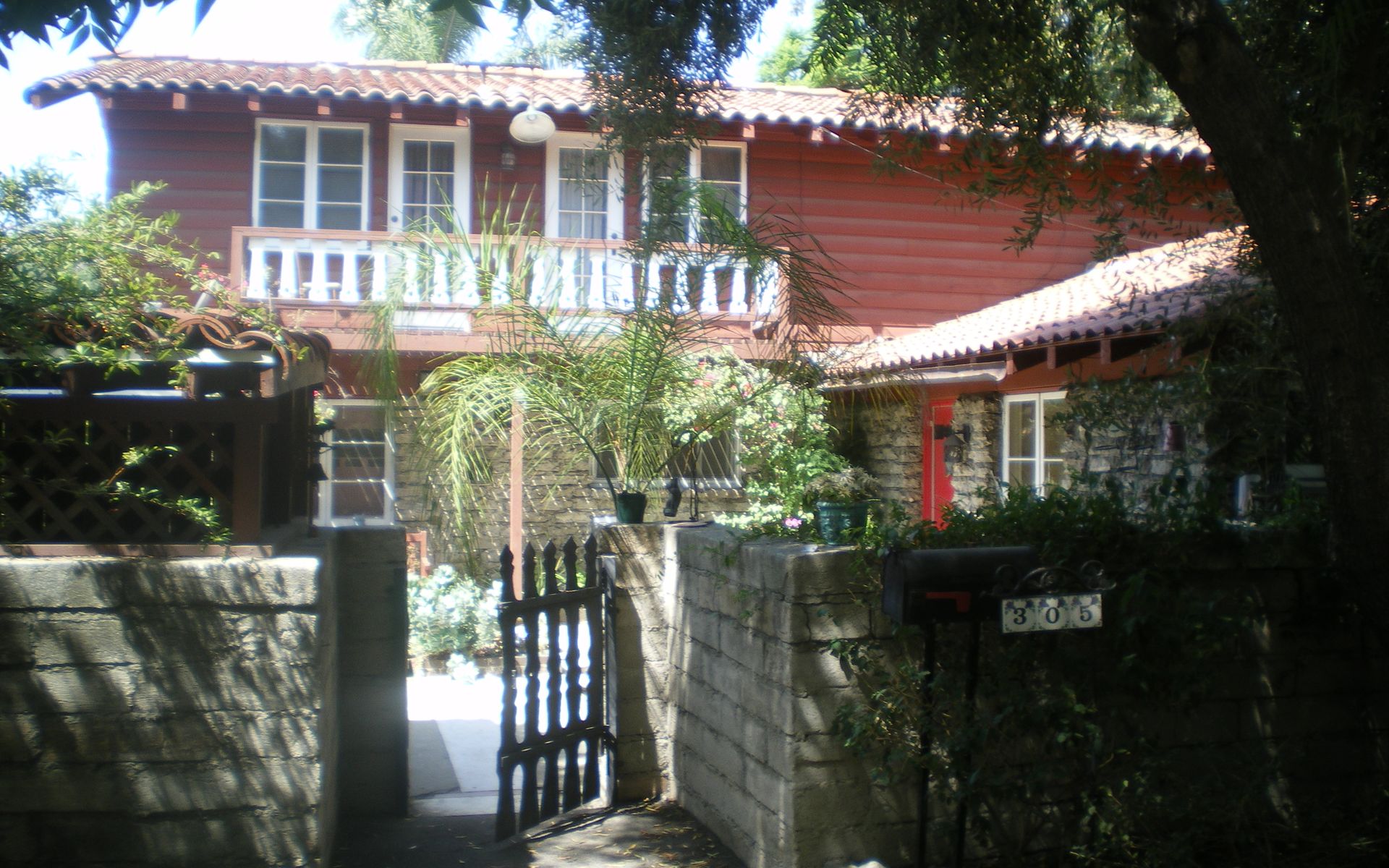
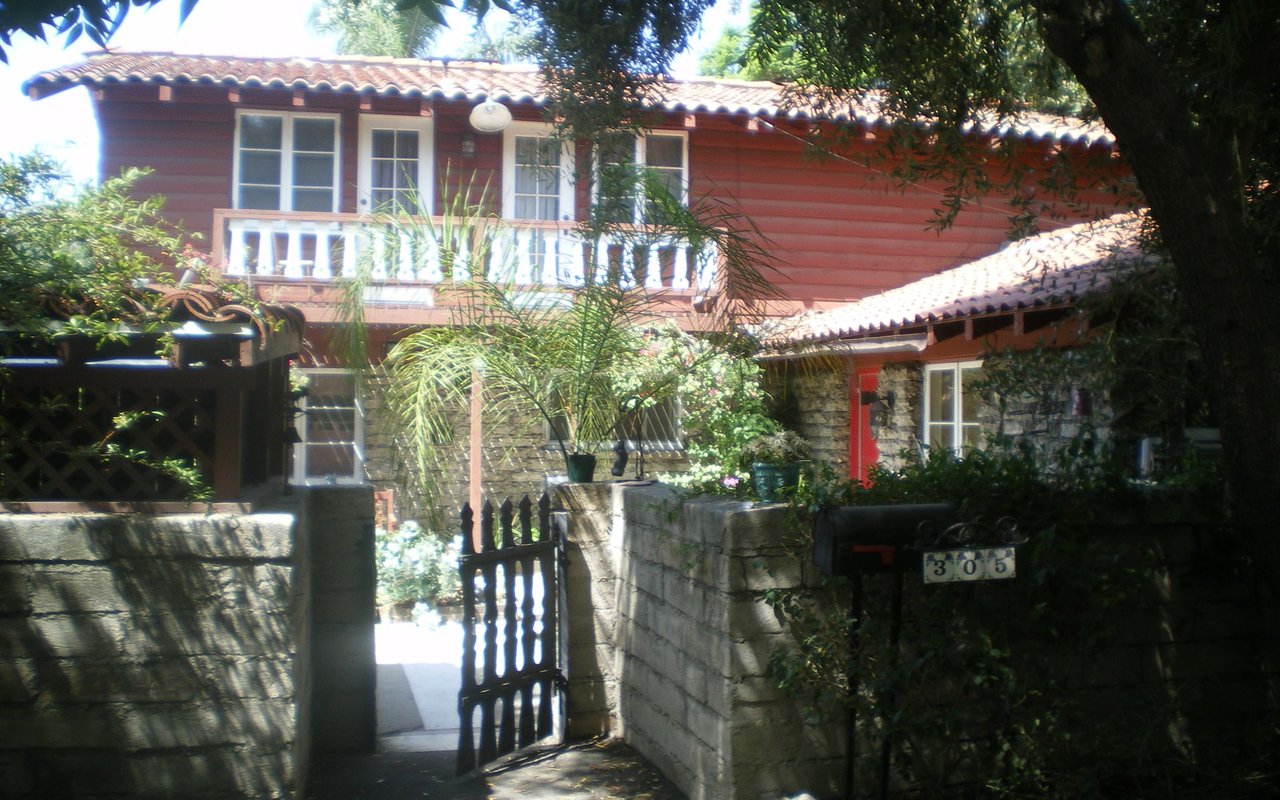
A Russian Village District home in an archival photograph. Architectural character calls for an equally careful look at condition and permitted work.
02 / Prices
A city median gives the search a scale. Comparable properties give an offer or asking price its foundation. In Claremont, begin by separating attached and detached homes, then compare neighborhood, condition, usable lot, layout and any view. Otherwise, a difference in the mix of properties can look like a change in the value of your house.
Redfin's all-home-types Claremont report for the three months ending July 2026 showed a $1,039,479 median sale price, down 0.53% year over year, and 39 days on market. See the publisher's city report and methodology. The period matters: these are reported closed-sale measures, not today's asking prices or a prediction of how long your listing will take. Figures were checked September 8, 2026.
The following comparison explains ownership questions, not quoted neighborhood price ranges. HOA obligations, special assessments and property taxes must be checked for the individual address and development. No citywide “yes” or “no” replaces the title, tax and association records.
Housing choice | Typical comparison | Ownership documents | Costs to investigate | Tour priority |
|---|---|---|---|---|
Historic and Old Claremont | Older detached homes with varied architecture | Permit history and any historic designation | Systems, roof, restoration and specialist work | Condition behind the finishes |
Village-area attached homes | Condominiums and multistory townhomes | Ownership form, association budget and reserves | Dues, assessments, master insurance and unit coverage | Stairs, parking, shared walls and actual walk |
Claremont Club area | Attached units versus detached houses | Association responsibilities; separate amenity terms | Exterior obligations and any optional memberships | Private space and maintained common areas |
North and Northeast Claremont | Established detached houses and larger residences | Parcel, permits and applicable development restrictions | Yard, pool, utilities and replacement costs | Usable land and floor plan |
Claraboya and Highpoint | Hillside houses and terraced townhomes | Title, association if applicable, slope and project records | Insurance, drainage and retaining structures | View, exposure and access |
Compare the monthly obligation as carefully as the purchase price. Use our mortgage calculator to organize a scenario, then replace assumptions with lender terms, actual tax information, insurance quotes and any association dues. Keep a separate reserve for repairs. A payment estimate that leaves out the work you already know the home needs will give you an incomplete comparison.
For an older home, separate necessary work from changes you simply prefer. A safe, functional kitchen can wait for a later redesign; a roof or drainage concern may affect the purchase decision immediately. Obtain the right inspections and written estimates during the applicable investigation period. Our contractor-selection guide offers a useful preparation checklist, while Claremont's planning department is the source for the local approval path.
Ask for Claremont comparable sales matched to the home you are considering.
03 / Schools
Check school eligibility against the property address before treating it as part of the purchase. A listing's school names, a nearby-school widget and a district attendance decision serve different purposes. Begin with Claremont Unified Student Services and its official School Locator for address and enrollment resources, and confirm the result directly with the district for the student's grade and intended school year.
The district's About CUSD page describes seven elementary schools, one middle school, two high schools and an adult school. The California Department of Education reports 6,011 students in Claremont Unified for 2025-26 in its district profile. That is districtwide enrollment, not a count of children in a particular neighborhood or a promise of space at a school.
Build a school comparison from what matters to the student: course availability, services, campus visits, schedules and the logistics of getting there. Ask how enrollment, transfers and specialized programs work before assuming that proximity provides admission. Keep notes on the source and date of each answer so an old listing description does not become the deciding evidence.
The Claremont Colleges are another part of the city's educational identity. Their presence can matter to people working, studying or visiting locally, but residential ownership does not carry college admission or general access to every facility. Check the institution's own event and visitor policies. If you are relocating for a campus job, test the trip to your specific building rather than using the word “colleges” as one destination.
For a first purchase, keep these verification steps beside the financing and inspection timeline. Our first-time buyer guide helps organize the broader process. The goal is a home that fits both the budget and the actual daily schedule, with important eligibility questions answered before they become an unwelcome surprise.
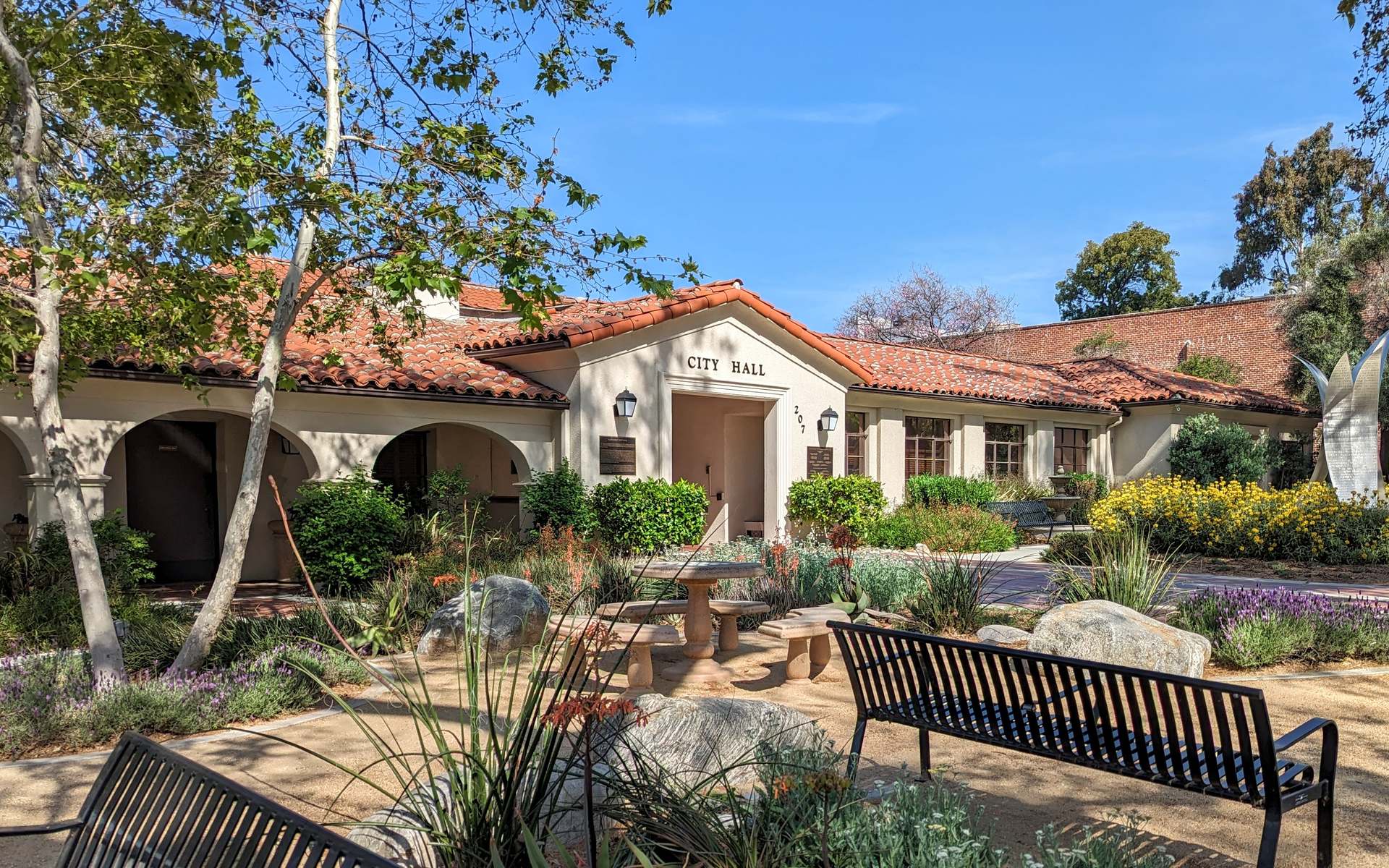
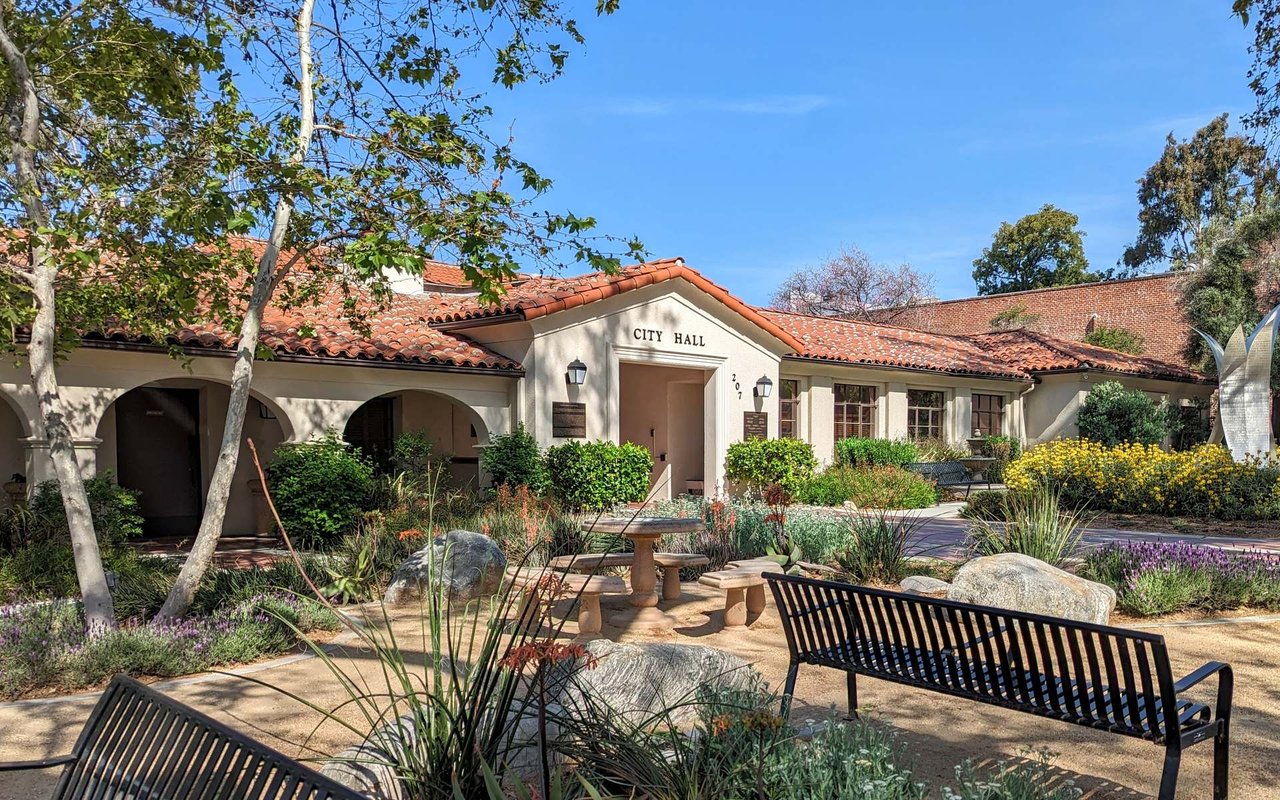
Claremont City Hall, April 2023. Use the responsible city or district office to resolve address-specific questions.
04 / Commute
Claremont's existing rail option and its future light-rail project need separate treatment. As checked September 8, 2026, Metrolink lists Claremont station at 201 W. First Street on the San Bernardino Line. The official station page links to schedules, parking, connections and advisories. Use the train you would actually take, in both directions, when comparing homes.
The Foothill Gold Line Construction Authority describes the 2.3-mile Pomona-to-Claremont A Line extension as a project in design and preconstruction. Its current forecast places major construction as early as late 2027, followed by approximately four years of construction. Those are project expectations, not an operating Claremont A Line service or a guaranteed opening date.
When comparing a home near the depot with one in the foothills, add the first and last part of the trip: leaving the garage, reaching a station entrance, parking where allowed and getting from the destination station to work. A listing can be geographically close to rail without making your particular work schedule easy. Check evening return options, weekends and any transfers you would rely on.
For driving, compare the routes to the 210 and 10 corridors from the actual neighborhood, then test the complete trip at your normal departure time. A freeway label tells you little about the final approach to a campus, office or job site. If you travel through Ontario International Airport, include the terminal, parking choice and return-hour traffic in that trial rather than adopting an all-day drive-time claim.
Visit the block at more than one time of day. Listen for passing trains, freeway sound or traffic on a connector road, and check how easy it is to turn into the driveway when streets are busy. An occasional inconvenience may be entirely acceptable if you value the location. The useful decision is to recognize it before the purchase and price the tradeoff honestly.
05 / Daily life
Think about Claremont as a collection of routines: a trip into the Village, an afternoon in the garden, a paved walk near the foothills or a longer trail outing when conditions allow. The best location for you is the one that makes your recurring activities convenient without adding costs or upkeep you do not want.
Claremont's Thompson Creek Trail is a 2.8-mile paved route, according to the city's trail description, checked September 8, 2026. It runs alongside the flood-control channel and has several access points. Compare the actual entrance you would use, parking arrangements and the route from a home. A property near the line on a map may still require a longer walk to join it.
The Claremont Hills Wilderness Park page describes more than 20 miles of trails, including the popular five-mile loop. At our September 8, 2026 review, the city posted a closure beginning August 25, 2026 until further notice because of a Red Flag Warning. Check the city's current notice before planning a visit. Trail access and seasonal hours can change; the proximity of a home does not guarantee a park is open on a particular day.
California Botanic Garden occupies 86 acres in Claremont, according to the garden's own description, checked September 8, 2026. Its focus is California native plants. For a homeowner considering a different landscape, a visit offers a chance to look at mature plant forms and seasonal appearance before buying for a yard. Consult the garden's admission and visitor information for current arrangements.
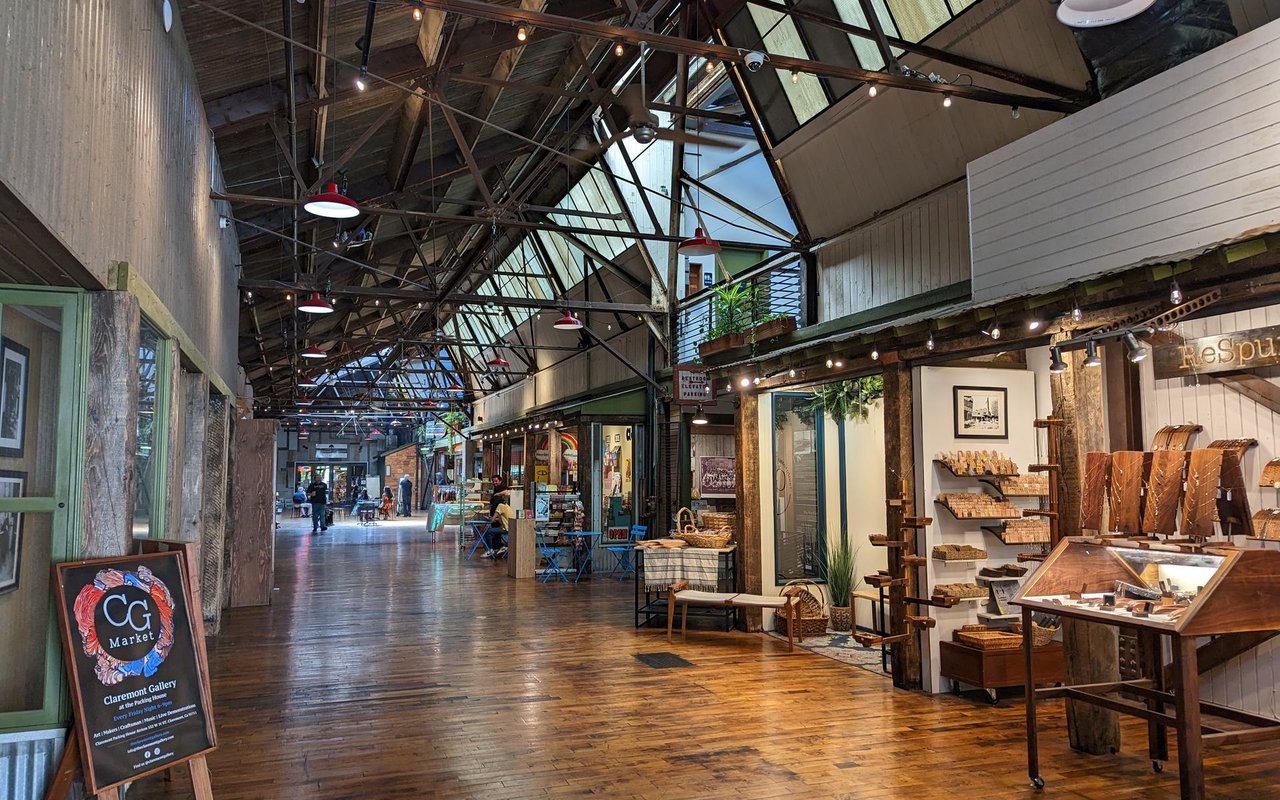
In the Village, make your own short list of places you expect to use and walk between them. Include practical errands as well as dinner or coffee. The Packing House gives the area another distinct setting, with its former industrial interior adapted for retail use. A pleasant weekend visit is helpful, but try the same trip when you have limited time and need to park, collect something and get home.
Outdoor space at home is another daily-life choice. Compare a private yard you maintain with a smaller patio and association-managed surroundings. Ask where equipment, bicycles and garden supplies will go. If you want the freedom to change landscaping or add shade structures, establish the approval requirements for that property before assigning value to the possibility.
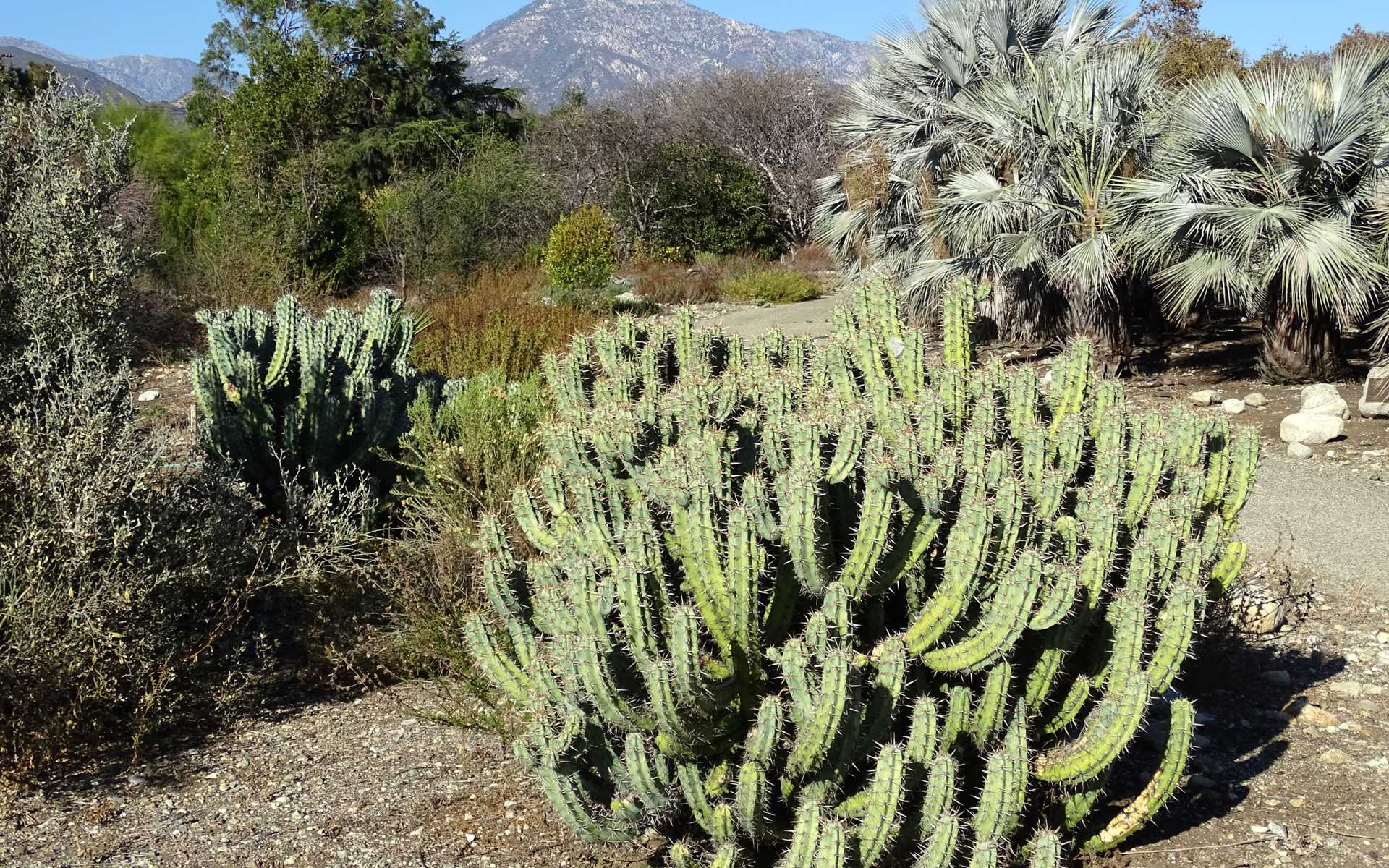
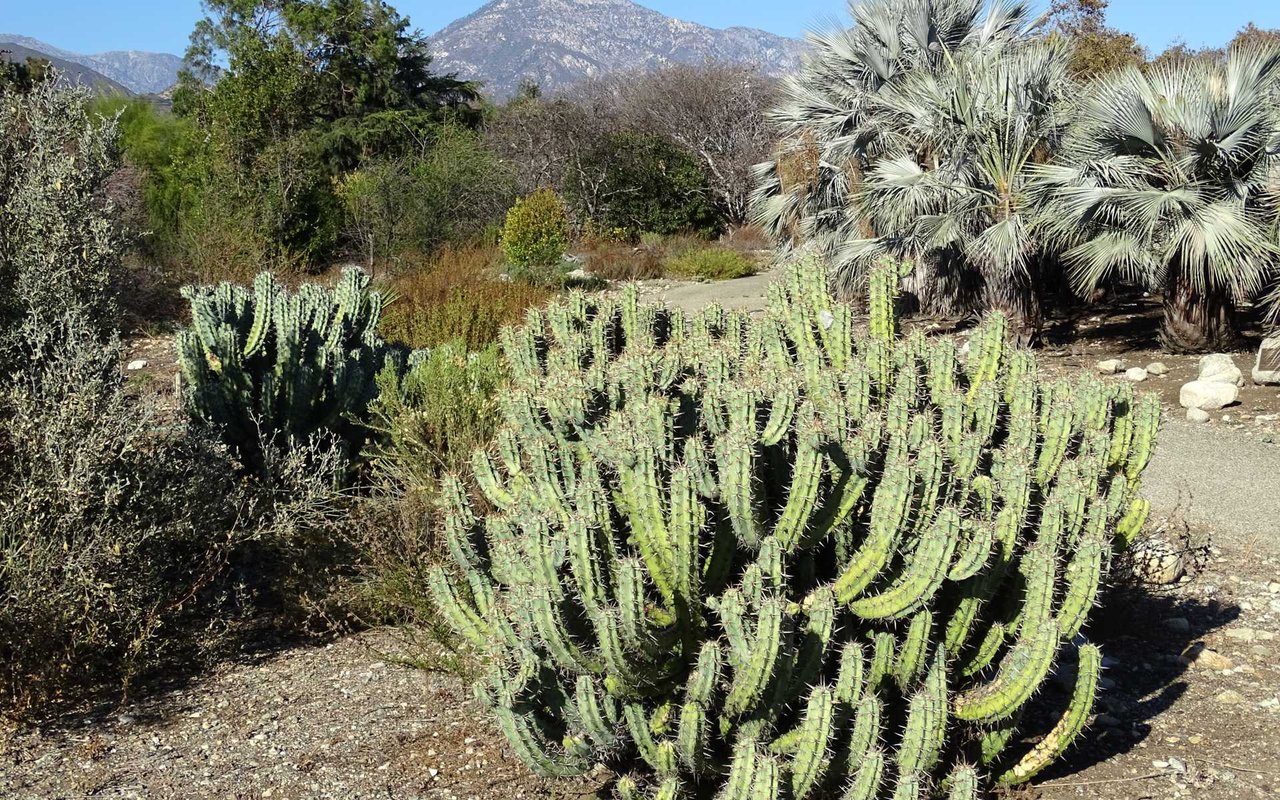
California Botanic Garden, October 2021. A landscape reference for the shape and texture of native planting.
06 / Selling
A strong Claremont listing makes the property's position within the city easy to understand. Show the floor plan, the useful outdoor space and the condition evidence, then explain the local details accurately. For an older home, organized permit and improvement records can help a buyer evaluate what has been preserved and what has changed. For a hillside property, make access, orientation and the usable portion of the lot clear.
Preparation should address the questions a buyer will carry into a second visit. Gather invoices and warranties, identify maintenance that needs attention, and decide with your agent which work deserves a contractor's estimate before launch. With attached housing, request association documents early so dues, responsibilities and any known assessments can be discussed from the records. For a distinctive house, avoid replacing character simply to make the rooms resemble a generic renovation.
Price against the most relevant recent competitors and closed sales, then account for condition and the terms buyers are likely to need. A broad city median cannot decide the premium for a better layout or the discount for necessary repairs. Choose the launch schedule around preparation, your move and the property's current competition. Ask Justin's team for a written explanation of the comparable set, a presentation plan and a way to evaluate feedback as the listing progresses.
Start with your address in our seller consultation, or use the home-valuation request to begin a discussion about the evidence behind a price range.
07 / Why Justin
Claremont deserves a comparison that respects the house and its setting. Justin Tye and the Active Realty team can help organize a shortlist, evaluate comparable sales and identify the address-specific questions to resolve with inspectors, lenders, insurers and the city. Tell us the parts of your move that are fixed and the tradeoffs you can make, so the search or selling plan begins with your actual priorities.
Our reviewed team archive contains 10 distinct historical Claremont transactions from July 2009 through September 2024. The table shows the eight most recent distinct records available in that archive. These are team transactions from CRMLS and archived Zillow records, not all Claremont sales, current market comparables or a claim that Justin personally represented every side. We matched city and eligible representation side, normalized street suffixes, and removed a repeated address/date record before counting. Archive reviewed September 8, 2026.
Street | ZIP | Closed | Sold price | Represented |
|---|---|---|---|---|
739 Huron Drive | 91711 | Sep 2024 | $772,000 | Buyer |
895 Connors Court | 91711 | Mar 2023 | $500,000 | Buyer |
885 Drake Avenue | 91711 | Jul 2021 | $640,000 | Buyer |
788 Marlboro Court | 91711 | May 2020 | $780,000 | Buyer |
884 Decatur Circle | 91711 | Feb 2019 | $660,000 | Seller |
2451 Bonnie Brae Avenue | 91711 | Sep 2016 | $710,000 | Seller |
259 Carver Drive | 91711 | Sep 2015 | $739,000 | Buyer |
1359 Cedarview Drive | 91711 | Apr 2013 | $535,000 | Seller |
For broader examples of the team's work, visit our past transactions. For your own decision, we will start again with the present property and the current market. Historical experience belongs in the conversation; the evidence for today's offer or asking price must come from an appropriate, current comparison.
Call (949) 381-8581, send a note about your Claremont plans, or start with our home-search resources. Justin Tye | CA DRE# 01728694.
08 / Questions
Redfin's Claremont city report gives a $1,039,479 median sale price across all home types for the three months ending July 2026. It is a broad reported-sales benchmark. Match the neighborhood, property type, condition and lot before applying it to an individual home.
Compare the routine and ownership work each one creates. For the Village, test walking routes, parking and the condition of an older structure. For the foothills, inspect access, exposure, usable land and address-specific insurance options. Then compare current properties with similar characteristics rather than treating all Claremont square footage as equivalent.
The Claremont extension is still a future project in the Construction Authority's September 2026 information. Metrolink's San Bernardino Line is the existing rail service at Claremont station. Verify current timetables and future-project updates separately when making a commute-based purchase decision.
No. Confirm the full address, grade and school year with Claremont Unified Student Services. Nearby-school results and listing descriptions do not establish attendance eligibility, transfer approval or space in a particular program.
Start by establishing the property's designation and the scope of the proposed work. The city's planning-permit resources and preservation staff can explain the relevant review. A home's age alone does not tell you whether a project will be allowed or which approvals it needs.
That is a property-level question. Obtain the current title, tax and association information for the address, including any supplemental tax considerations and assessments. For an attached home, also establish which building components the association covers. Do not treat a neighborhood label or a listing's abbreviated fee field as the complete ownership cost.
Review the city's current hazard-map resources, obtain an insurance quote, and investigate the lot's access, drainage and retaining structures with appropriate professionals. A hazard designation is a starting point for research; it does not establish the condition or insurability of a particular house.
Share the address, improvements, known work needed and preferred timing. Ask for the recent comparable set, the adjustments that matter and the competing active listings. A useful range explains why buyers might compare your home with those properties and what preparation could improve its presentation.
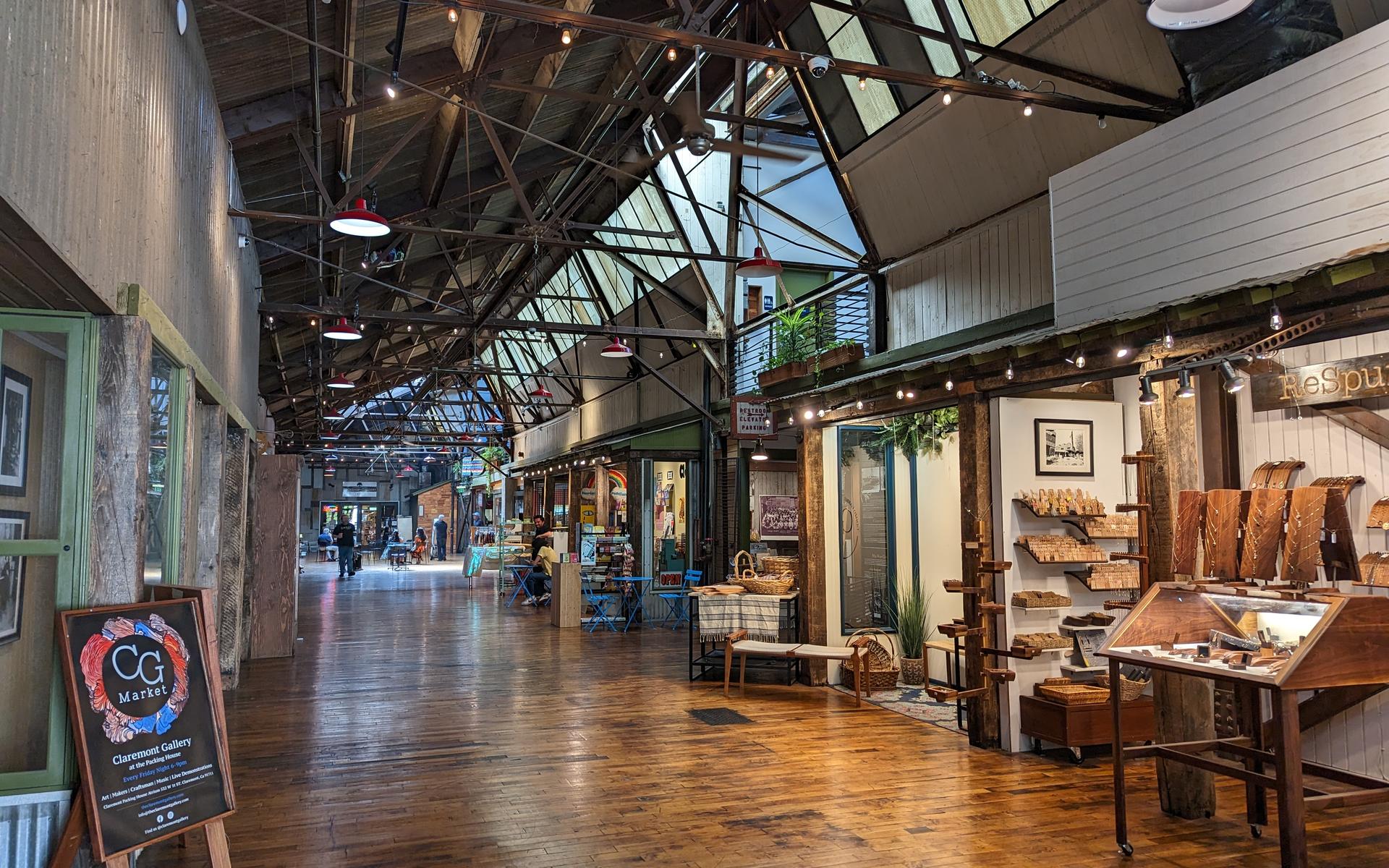
Inside the Claremont Packing House, April 2023. The Village's reused buildings give its commercial spaces a distinct character.
Continue with our Los Angeles County real estate overview. For a broader location comparison, explore the City of Los Angeles guide or Alhambra's neighborhoods; these are separate markets and jurisdictions, not adjacent Claremont neighborhoods. Our bungalow and courtyard-home guide offers another way to refine the type of home you want.
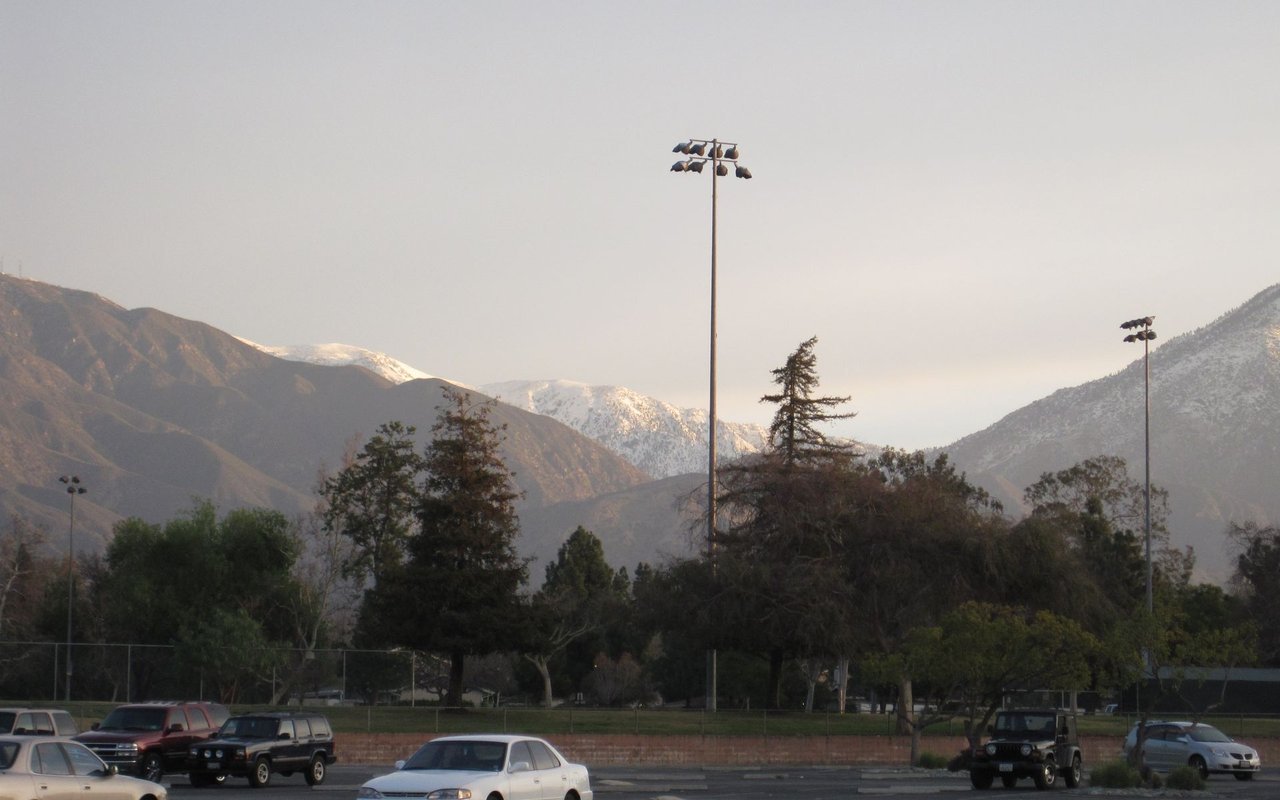
Photographs document their stated dates and do not represent current listings. Verbal Building: The Marmot, CC BY 2.0. Russian Village house: Cbl62, CC BY-SA 3.0. City Hall and Packing House: Sdkb, City Hall and Sdkb, Packing House, CC BY-SA 4.0. California Botanic Garden: Adam Jones, CC BY 2.0. Gallery mountain view from Claremont High School: Abpotato, public domain, January 2010. Web copies resized, cropped and compressed; adapted CC BY-SA photographs retain their stated licenses.
For a nearby housing comparison, explore Pomona's historic districts, Phillips Ranch and rail connections. Check the separate city guide when weighing architecture, daily routes and ownership costs against Claremont.
For an adjacent-city comparison, explore Upland's historic Euclid Avenue districts, Colonies housing and downtown rail connection. Compare the individual homes, ownership costs and daily routes with your Claremont shortlist.